People Counting System Price in Bangladesh 2026 | GCTL Security
People Counting System Price in Bangladesh
People Counting System Price in Bangladesh usually starts from around ৳8,000–৳25,000 for basic infrared counters. Advanced overhead, 3D, ToF or AI-powered visitor counting systems can range from ৳45,000 to ৳1,50,000 or more depending on accuracy level, sensor technology, dashboard features, entrance width, installation complexity and technical support.
For retail chains, malls, airports, large buildings and multi-entrance projects, the total cost can increase because multiple sensors, cloud dashboard, analytics software, network configuration and reporting features may be required. GCTL Security provides project-based quotation so customers can select the right system according to site layout, visitor flow and reporting needs.
| People Counting System Type | Best For | Estimated Price Range |
|---|
| Basic IR People Counter |
Small shops, single entrances, simple visitor count |
৳8,000 – ৳25,000 |
| Doorway Visitor Counter |
Retail stores, offices, libraries, showrooms |
৳25,000 – ৳55,000 |
| Overhead People Counter |
Shopping malls, supermarkets, museums, large stores |
৳45,000 – ৳1,50,000+ |
| AI Visitor Counting System |
High-footfall commercial and public spaces |
৳50,000 – ৳1,50,000+ |
| Retail Footfall Counter with Dashboard |
Retail chains, showrooms, business analytics |
৳65,000 – ৳2,50,000 |
| Multi-Entrance People Counting System |
Malls, airports, large facilities, chain stores |
৳2,00,000 – ৳8,00,000+ |
What is a People Counting System?
A people counting system is a visitor counting solution that counts how many people enter, exit or move through a specific area. It can be installed at doors, entrances, corridors, retail zones or public facilities to measure footfall and visitor movement.
Basic counters use infrared sensors to count entry and exit movement, while advanced people counting systems use overhead 3D sensors, ToF technology or AI analytics to improve counting accuracy. For business owners and facility managers, this data helps understand customer traffic, staffing requirements, peak hours, occupancy trends and space utilization.
Types of People Counting Systems
Different types of people counting systems are available in Bangladesh. The right solution depends on the entrance size, visitor flow, reporting requirement and business objective.
Infrared People Counter
An infrared people counter is a simple and budget-friendly option for small shops, offices and narrow entrances. It is suitable for basic visitor count where advanced reporting or high accuracy in crowded situations is not required.
Doorway Visitor Counter
A doorway visitor counter is installed at the entrance to count people entering and leaving a specific area. It is useful for retail stores, libraries, offices, showrooms, museums and service centers that need daily visitor count reports.
Overhead People Counter
An overhead people counter is installed above the entrance or walkway. It provides better accuracy than basic side-mounted sensors and is suitable for retail stores, shopping malls, supermarkets and high-traffic commercial spaces.
3D and AI People Counting System
3D and AI people counting systems provide advanced counting accuracy, direction detection, staff filtering, occupancy measurement and dashboard-based reporting. These systems are suitable for businesses that need reliable visitor analytics and data-driven decision making.
Multi-Entrance People Counting System
Large facilities such as malls, airports, hospitals, universities and retail chains may need multiple sensors across different entrances. A multi-entrance people counting system can collect data from several locations and show centralized reports through a dashboard.
Footfall Counter vs AI People Counting System
A footfall counter is mainly used to count the number of visitors entering or leaving a store or building. It is useful for understanding basic traffic volume. An AI people counting system provides more advanced analytics, such as visitor flow, direction, occupancy, heatmap, staff exclusion and reporting by time, day or location.
| Feature | Basic Footfall Counter | AI People Counting System |
|---|
| Counting Accuracy |
Basic to moderate |
Higher accuracy with advanced filtering |
| Best Use |
Small shops and simple entrances |
Retail stores, malls, airports and commercial facilities |
| Reporting |
Basic count report |
Dashboard, trend, peak hour and occupancy reports |
| Analytics |
Limited |
Visitor flow, conversion, heatmap and zone analytics |
| Project Cost |
Lower budget |
Higher budget with more business value |
Which People Counting System Is Best for Your Business?
The best people counting system depends on your business type, entrance layout and reporting needs. A small boutique may only need a basic visitor counter, while a shopping mall or retail chain may need multiple overhead sensors with a centralized dashboard. For high-traffic locations, 3D or AI-powered people counting systems are recommended because they provide better accuracy and more useful business insights.
| Business Type | Recommended Solution | Main Purpose |
|---|
| Small Retail Shop |
Basic IR or doorway visitor counter |
Daily visitor count and simple traffic tracking |
| Supermarket or Showroom |
Overhead people counter |
Peak hour tracking and customer flow analysis |
| Shopping Mall |
Multi-entrance people counting system |
Centralized visitor analytics and occupancy monitoring |
| Retail Chain |
AI visitor counting with dashboard |
Branch comparison, conversion tracking and reporting |
| Airport, Hospital or Public Facility |
Advanced people counting and occupancy solution |
Crowd management, space planning and safety monitoring |
Key Features to Check Before Buying
Before buying a people counting system in Bangladesh, buyers should compare both hardware and software features. The cheapest counter may not provide accurate data in busy entrances, wide doors or crowded environments. For business analytics, dashboard and report quality are just as important as the sensor itself.
- Counting Accuracy: Choose a system that can count visitors reliably in your entrance condition.
- Sensor Technology: IR, 3D, ToF and AI technologies offer different accuracy levels and price ranges.
- Entrance Width: Wide entrances may need multiple sensors or advanced overhead counters.
- Dashboard Reporting: Useful for daily, weekly, monthly and branch-wise traffic reports.
- Occupancy Monitoring: Helps track how many people are inside a location at a specific time.
- Peak Hour Analysis: Helps plan staff schedules, service counters and customer support.
- Multi-Branch Support: Important for retail chains, supermarkets and organizations with multiple locations.
- Installation and Calibration: Proper installation is important for accurate counting performance.
- After-Sales Support: Technical support, training and maintenance help keep the system reliable.
How Many People Counters Do You Need?
The number of people counting sensors depends on entrance width, mounting height, doorway design, visitor density and the level of accuracy required. For a narrow single-door entrance, one sensor may be enough. For wide entrances, double doors, multiple entry points or open areas, more than one counter may be needed.
GCTL Security can inspect your site layout and suggest the right number of sensors based on entrance size, traffic flow and reporting requirements. This helps avoid under-counting, over-counting and incorrect visitor analytics.
How People Counting Helps Retail Analytics
People counting is valuable for retail businesses because it shows how many visitors come to the store, when traffic is highest and how customer movement changes over time. When this data is compared with sales data, businesses can understand conversion rate and store performance more clearly.
Retail managers can use people counting reports to improve staff planning, campaign timing, store layout, service counter placement and branch comparison. For stores using promotional screens or customer communication displays, people counting data can also support better planning with Digital Signage Display solutions.
Privacy-Safe Visitor Counting
Modern people counting systems can count visitors without storing personal identity data. Depending on the device type, counting may use infrared beams, 3D depth sensing, ToF sensors or anonymous AI analytics instead of facial recognition. This helps businesses collect useful traffic data while keeping visitor privacy in mind.
For offices, commercial buildings and high-security locations, people counting can also work with Access Control System, Queue Management System and CCTV Camera System solutions to improve visitor management, safety and operational efficiency.
Why Buy People Counting System from GCTL Security?
Buying a people counting system is not only about installing a sensor. The system must be selected, installed, calibrated and configured properly to provide useful data. GCTL Security helps customers plan the right people counting solution based on entrance layout, business goal, visitor traffic and reporting needs.
- Professional Consultation: We help select the right counter based on entrance width, visitor flow and business type.
- Reliable Product Supply: GCTL Security supplies visitor counters, footfall counters and advanced people counting systems.
- Installation and Calibration: Proper setup helps improve counting accuracy and long-term performance.
- Dashboard and Reporting Support: We help businesses use visitor data for better decision making.
- Project-Based Quotation: Suitable for retail shops, malls, offices, hospitals, airports and multi-branch businesses.
- Complete Security Integration: People counting can be planned with entrance security, access control, CCTV and queue management systems.
For retail stores that also need product protection, GCTL Security can provide EAS Security System solutions to reduce shoplifting and improve retail safety.
Get People Counting System Price in Bangladesh
If you need to count visitors, analyze footfall, monitor occupancy or understand customer traffic, a people counting system can be a valuable investment. The right system can help improve business planning, staff management, customer service and operational decisions.
Contact GCTL Security to get the latest People Counting System Price in Bangladesh, FootfallCam 3D people counter quotation, visitor counter price, AI people counting system price and complete installation support based on your site requirement.
Final Thought
A People Counting System is no longer a “nice-to-have” in Bangladesh, it’s a practical tool for smarter retail and facility management. If your goal is basic footfall numbers, a simple Footfall Counting Machine can work. But if you care about decision-making peak hours, conversion rate, staffing, and customer experience an Overhead People Counter with a reporting dashboard delivers significantly better value over time. The best choice is the one that matches your entrance complexity, accuracy needs, and long-term reporting goals backed by strong installation and support.
 |
 |
 |
|
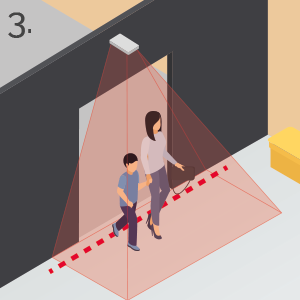
1. Install People Counting Device: Mount device face down above entrance-way
to the area you want to count people in or out of.
|
2. Configure Count Lines: Use the setup tools to draw invisible
lines that count the number of people that cross them.
|
3. Collect Count Data: Sit back and relax as accurate count
data is collected automatically.
|
Frequently Asked Questions
What is a people counting system?
A people counting system is a visitor counting solution that counts how many people enter, exit or move through a specific area. It is used for retail analytics, occupancy monitoring, visitor tracking and business planning.
What is the People Counting System Price in Bangladesh?
People Counting System Price in Bangladesh usually starts from around ৳8,000–৳25,000 for basic infrared counters. Advanced overhead, 3D or AI-powered systems can cost more depending on technology, dashboard features, installation and support.
Which people counter is best for retail stores?
For retail stores, an overhead or 3D people counter with dashboard reporting is usually better than a basic counter because it provides more accurate visitor data, peak hour reports and business analytics.
Can a people counting system show peak hours?
Yes. Advanced people counting systems can show peak hours, visitor trends, daily reports, occupancy data and branch-wise performance through a dashboard.
Does people counting use facial recognition?
Not always. Many modern people counting systems use infrared, 3D depth sensing, ToF or anonymous analytics to count visitors without identifying individual people.
Does GCTL Security provide installation support?
Yes. GCTL Security provides people counting system supply, installation, calibration, dashboard setup and after-sales support in Bangladesh.